
How EOR Helps Companies Build a Borderless Workforce
Across industries, many organizations are turning to a more borderless operating model, hiring, working, and transacting with fewer locational restraints. While this is creating new opportunities in operational agility and the ability to optimize team construction, borderless organizations also see challenges.
One prominent challenge is managing the web of payroll, taxes, and HR regulations related to having an international workforce. One solution that helps organizations become more global is Employer of Record services. Often abbreviated as EOR, these services help borderless organizations tackle the future of work with efficiency and compliance.
As the borderless workforce evolves, EOR is transforming from a compliance tool to a critical building block of Future of Work infrastructure. EOR is more than a simple HR workaround. It’s a core layer in global operating models.
What is a Borderless Workforce?
A shift toward remote hiring, where workers and teams aren’t tied to a physical office, has led to the rise of the borderless workforce. This model means organizations operate beyond physical and geographical boundaries using digital collaboration and remote work technologies. Workers benefit from the increased access to job opportunities and employers benefit from the ability to choose from a broader talent pool.
For people who prefer remote work, such as digital nomads, the borderless workforce increases the number of available opportunities. At the same time, this borderless workforce ecosystem promotes the type of cross-cultural opportunities that many of these workers seek.
The differences between borderless and remote work don’t end there. Borderless work requires a much more nuanced cross-border operating model, taking into account laws, regulations, currency considerations, and different cultures. At its root, a borderless workforce extends the flexibility of remote work beyond an organization’s fixed geographical footprint.
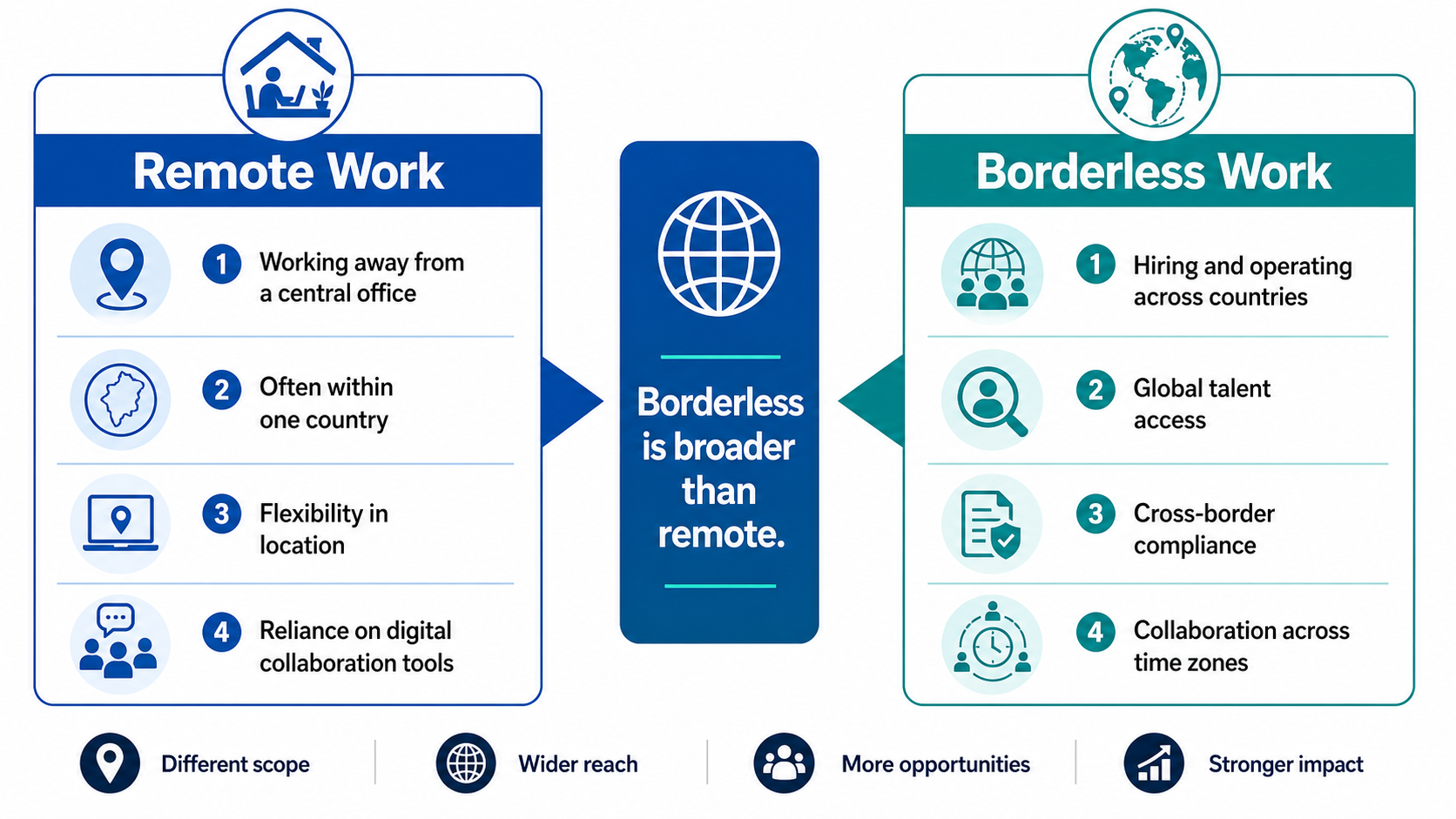
This graphic shows how borderless work takes on a more expansive scope than traditional remote work.
While there are obvious benefits for borderless workers and organizations seeking a more global presence, becoming a borderless workplace entails major upfront efforts and ongoing work to ensure global compliance. Before we dive into these challenges and how an Employer of Record addresses them, let’s talk about some of the trends around borderless hiring.
Why Borderless Hiring is Growing
Beyond traditional labor arbitrage, contemporary workforce trends are creating an environment ripe for an increase in borderless hiring. In 2022, Gartner estimated that the proportion of borderless technology workers had approximately tripled to 58% over the course of three years.
It is fair to assume two things: this growth was driven by pandemic-related necessity and current RTO trends may be blunting this momentum. However, the increase of remote and borderless work during the first half of this decade revealed many reasons why the borderless economy is here to stay. Among these:
Access to global talent pools. Drawing from a wider population connects organizations in desperate need of skills to qualified workers who may not be able to find the right opportunity in their homeland. Common borderless jobs include software development, IT support, marketing, and creative work.
Hybrid teams. Modern collaboration tools mean that teams can work together no matter where each member sits. Some organizations have even reduced their physical office footprint. This means that new hiring is often dependent on remote workers.
Faster hiring. Global talent pools ideally make finding the right candidate easier. Bypassing in-person interviews may also reduce common friction that extends interview cycles.
Workforce flexibility. All of the above factors are examples of how borderless hiring removes traditional constraints and provides new flexibility when adding workers.
Project-based work. As economic uncertainties persist, many organizations have shifted toward hiring for contract and project-based roles. Global talent marketplaces, such as Upwork and Fiverr, have lent to more organizations re-orienting themselves around a borderless mindset.
The Challenges of Hiring Across Borders
Borderless hiring isn’t as simple as finding talented workers and shipping them laptops. There are complex legal structures to put in place, including:
Entity setup. Hiring international workers often means setting up a legal entity to be able to do business in the jurisdictions where these employees live.
Payroll. Paying workers across borders means handling local pay cycles, currency conversion, statutory deductions, and country-specific payroll rules.
Benefits. Employers often need to provide locally compliant benefits packages, including healthcare, pension contributions, leave, and other mandated perks.
Tax complexity. Cross-border hiring can trigger corporate tax, employment tax, withholding, and permanent establishment issues that vary by jurisdiction.
Local labor laws. Each country has its own rules for contracts, working hours, termination, notice periods, and employee protections.
Compliance risks. Mistakes can lead to fines, misclassification claims, audit exposure, back-pay obligations, and reputational damage.
These challenges can make borderless hiring complex. For many organizations, having to handle these challenges and their related risks can dissuade them from considering a borderless strategy. This is where Employers of Record come in.
What an Employer of Record (EOR) Does
As the benefits and challenges of borderless hiring have become understood, Employer of Record (EOR) solutions have emerged. Gartner defines Employer of Record (EOR) as a solution that allows companies to hire, onboard, and manage employees in multiple countries without having to establish a local entity.
In other words, the EOR acts as the legal employer in the country where the worker is hired. EOR handles payroll, taxes, benefits, compliance, and other legal requirements. While the EOR is the legal employer on paper, the hiring company manages the remote employee just like any other worker.
For example, a Brazilian developer can take a remote job with a US company, completing her onboarding in days without the employer having to open a Brazilian entity. She is paid as an employee of a Brazilian company, in Brazilian Reais, on a typical Brazilian pay cycle.
How EOR Makes Borderless Hiring Possible
With the legal, compliance, and administrative requirements of the employee’s residence handled on the back-end, EOR makes it much easier for companies to expedite borderless hiring. Instead of spending time and money on complicated entity setup and maintenance, organizations can pay a fixed fee per employee or percentage of total remote payroll with EOR.
This speeds up hiring, enabling access to a more competitive talent pool. Organizations are less likely to miss out on sought-after talent due to long onboarding cycles. This also leads to a smoother employee experience, as it lends to a more seamless experience in getting paid and receiving benefits. When used correctly, an EOR employee’s experience should be virtually identical to that of a non-EOR employee.
Business Benefits of EOR
EOR allows businesses to have hire borderless workers with speed and agility, while lowering administrative burden and compliance risk. The graphic below illustrates these benefits further:
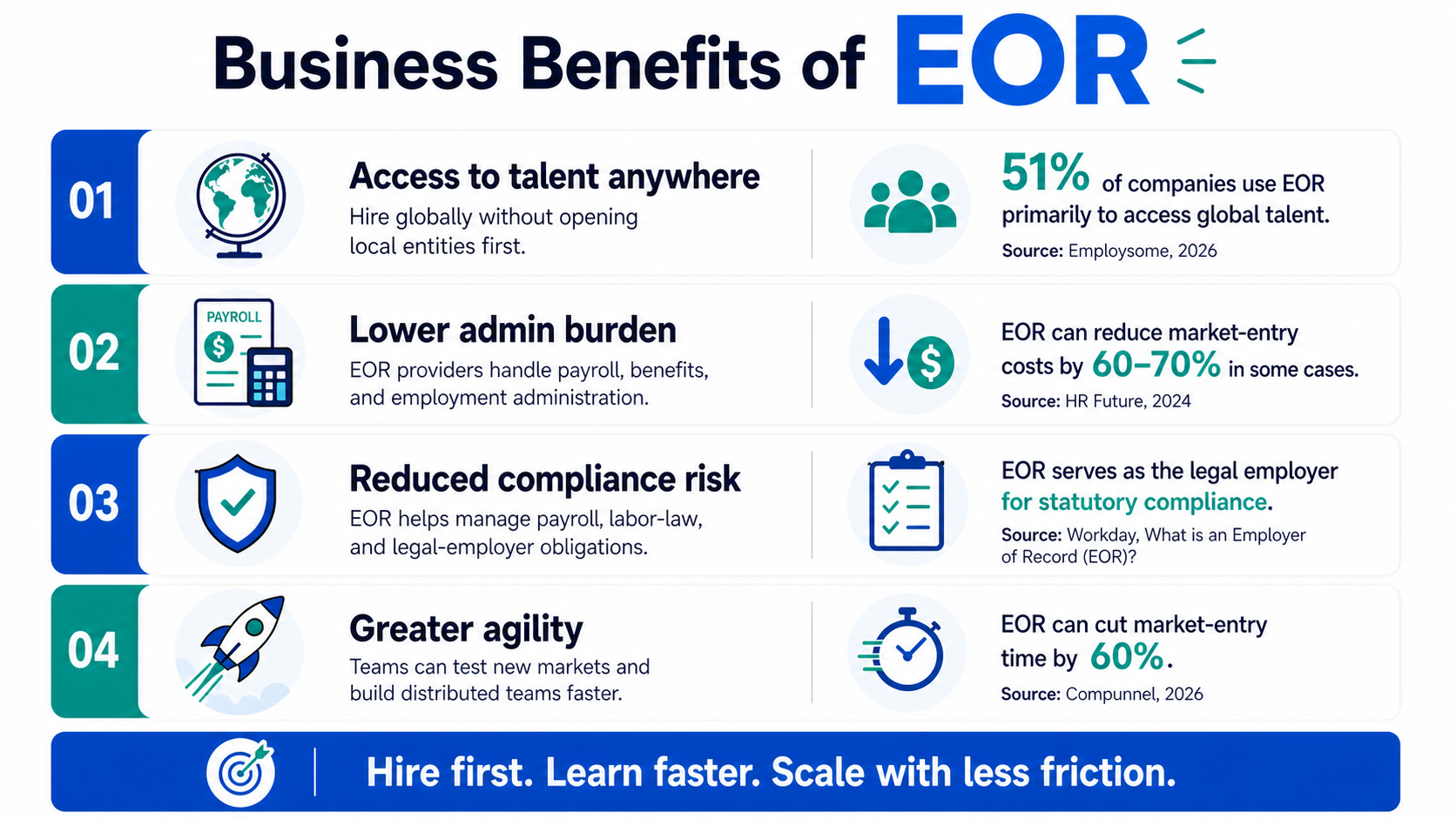
Sources: Employsome, HR Future, Workday, Compunnel
Where EOR Fits in The Future of Work
EOR is a critical part of the infrastructure enabling the borderless future of work. Organizations hiring digital nomads and other borderless workers will increasingly depend on EOR to reduce administrative burden, ensure compliance, and provide a seamless experience no matter where individual workers are located.
This will enable companies to draw from the widest talent pools, reduce hiring friction, and ultimately increase competitive advantage through workforce agility and a global perspective. As fractional careers and self-employment are expected to become more common, EOR is one of many tools that facilitate opportunities for employees and employers.
When Companies Should Use EOR
EOR isn’t the answer for all companies expanding their global presence. There are many different considerations depending on a business’ specific characteristics. Here are some scenarios where an EOR might make sense.
Expanding into a new country without local infrastructure. As mentioned, EORs reduce the time to gaining the legal ability to hire employees in a particular country. When time is of the essence, an EOR can help you move quickly.
Hiring one or a few employees in a market. EORs are great for getting started in a new country. However, their benefits are thought to diminish at around the 15 employee mark. Growing companies should have a plan for what happens as their headcount increases and be prepared to consider entity setup if they reach this threshold.
Testing market demand before committing to a new locale. For companies testing the waters of expansion to a new country, an EOR can make it easier to get started with smaller experimental operations before committing to scale.
Hiring specialized talent where local availability is limited. This will be one of the most enduring EOR use cases for its ability to quickly connect companies to the right talent when that talent lives in another country.
Choosing the Right EOR Partner
There are many considerations for choosing the right EOR partner. Among the most important ones:
Coverage in target countries. Not all EORs support every country. Users should check coverage lists to ensure that any country they want to hire from is supported. In some cases, it may make sense to use an EOR that specializes in certain target countries.
Strength of compliance and local legal support. It is important to research other users’ experiences with legal and compliance features as well as verify coverage documentation for region-specific needs.
Payroll, benefits, and onboarding quality. Similarly, research the experiences of employers and employees on the ease with which payroll is executed, benefits administered, and smoothness of onboarding.
Pricing transparency. Whether headcount-based or percentage-based, pricing should be transparent and able to plug into employers’ financial models for responsible budgeting and headcount planning.
Employee experience and support. When there are changes in status and unforeseen situations, understand how the EOR supports the employee. The employee’s experience with the EOR will directly translate into their experience with the company.
Choosing the right EOR partner will depend on geography and specific business requirements. Examples of vendors offering EOR solutions include Globalization Partners (G-P), Remote, Papaya Global, Rippling, Deel, Workmotion, Oyster, Borderless AI, and country-specific solutions such as Wisemonk for India.
Conclusion: EOR Is Critical for Borderless Work Strategy
The future of work is borderless, and EOR is an important part of many companies' borderless operational layer. EOR is not an HR workaround, but a strategic enabler allowing globally-oriented businesses to be more agile in hiring the right professionals. Choosing the right EOR is a critical part of borderless hiring strategy and organizations that get this right are poised to be more competitive, adaptable, and globally competent.
Positioning your platform in a crowded EOR market? Greenefield Consulting helps EOR firms and other innovators of the borderless economy tell their stories and market more effectively. Contact us for a complimentary consultation on how we can help your product marketing, content creation, and analyst relations strategies stand out.
